Chinmaya Vision Program Class 9 & 11

- Description
- Curriculum
- FAQ
- Notice
- Reviews
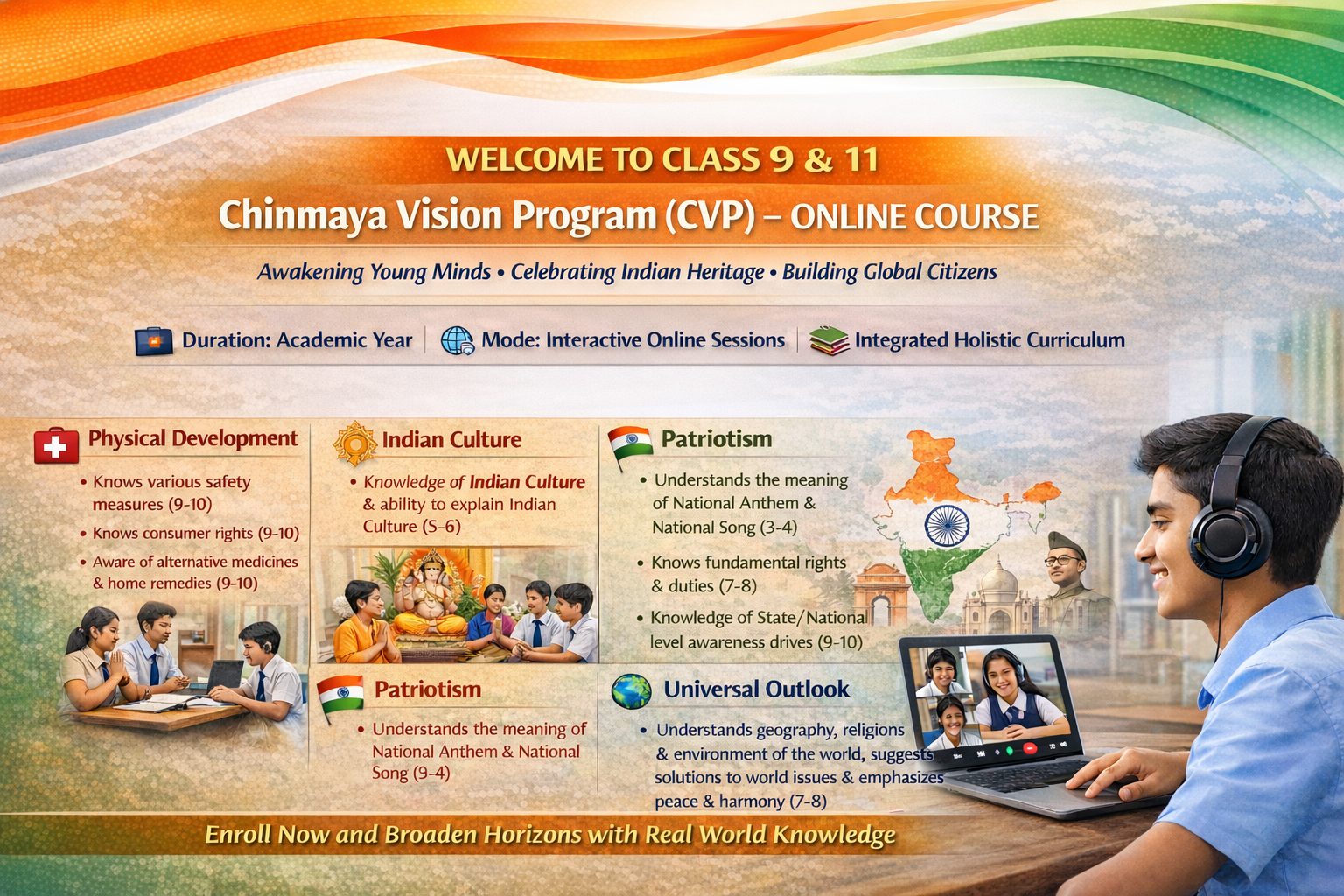
The Chinmaya Vision Program (CVP) for Classes 9 and 11 is a value-based developmental course designed to nurture holistic growth in senior secondary learners. This program bridges academic knowledge from the NCERT/CBSE curriculum with real-life applications, helping students evolve into physically confident, culturally rooted, nationally aware, and globally responsible individuals.
Throughout the academic year, students engage in meaningful learning experiences across four integrated dimensions, each directly connected to their prescribed textbooks and syllabus.
💪 Physical Development
NCERT Connect: Science (Chemistry, Biology), Economics (Chapter 5)
In this dimension, students go beyond basic life skills to develop a comprehensive understanding of personal and community well-being.
Students learn:
-
Advanced Safety Measures: Laboratory safety protocols (handling chemicals, acid spills), road safety, disaster management (earthquake, fire, flood), and first aid for fractures, burns, and choking.
-
Consumer Rights: Understanding the Consumer Protection Act, 2019; the six consumer rights; quality marks (ISI, Agmark, Hallmark, FPO); and the procedure for filing complaints in consumer courts.
-
Alternative Medicines & Home Remedies: Awareness of AYUSH systems (Ayurveda, Yoga, Unani, Siddha, Homeopathy); traditional home remedies for common ailments (turmeric for wounds, ginger-honey for cough, ajwain for indigestion); and the scientific basis behind these practices.
This segment builds informed, health-conscious, and empowered individuals who can handle real-life situations with confidence and knowledge.
🏵️ Indian Culture
NCERT Connect: History (Ancient, Medieval, and Modern India)
Students explore the depth and diversity of Indian culture, moving beyond rituals to understand the philosophical and spiritual underpinnings of traditions.
Students learn to:
-
Explain the essence of Indian culture: Unity in Diversity, respect for elders, festival celebrations, and the concept of “Vasudhaiva Kutumbakam” (the world is one family).
-
Appreciate India’s classical and folk arts: Bharatanatyam, Kathak, Odissi, Hindustani and Carnatic music, and traditional crafts.
-
Understand the historical evolution of Indian culture through various dynasties and their contributions to architecture, literature, and philosophy.
-
Analyze how Indian culture has absorbed and assimilated external influences while retaining its core identity.
This dimension fosters cultural pride, rootedness, and the ability to articulate India’s unique civilizational heritage.
🇮🇳 Patriotism
NCERT Connect: History (Freedom Struggle), Political Science (Constitution, Rights and Duties)
This dimension cultivates informed and responsible citizenship by connecting students with India’s freedom struggle and constitutional framework.
Students explore:
-
National Anthem & Song: The profound meaning behind Jana Gana Mana (Rabindranath Tagore) and Vande Mataram (Bankim Chandra Chatterjee); their historical context and emotional significance.
-
Fundamental Rights & Duties: Detailed study of the six Fundamental Rights (Articles 14–32) and eleven Fundamental Duties (Article 51A); the relationship between rights and responsibilities.
-
India’s Contributions: Understanding India’s gift to the world in mathematics (zero, decimal system), science (astronomy, medicine), and philosophy (yoga, non-violence).
-
National Awareness Drives: Knowledge of major campaigns like Swachh Bharat Abhiyan, Beti Bachao Beti Padhao, POSHAN Abhiyaan, and Pulse Polio; the role of citizens in these drives.
This segment develops patriotic, law-abiding, and socially conscious citizens who understand their role in nation-building.
🌍 Universal Outlook
NCERT Connect: Geography (Physical and Human Geography), History (World History), Political Science (International Relations)
Students expand their vision beyond national boundaries to embrace the world as their extended family.
Students learn to:
-
Understand Geographic Regions: Identify major geographic regions of the world (mountains, deserts, rainforests, grasslands, polar regions) and their environmental characteristics.
-
Understand World Religions: Gain basic knowledge of major religions—Hinduism, Islam, Christianity, Sikhism, Buddhism, Jainism—and their core teachings of compassion and peace.
-
Analyze Global Issues: Examine pressing world issues such as climate change, poverty, terrorism, and conflict; understand their causes and effects.
-
Suggest Solutions: Propose practical solutions like renewable energy, afforestation, interfaith dialogue, and international cooperation through organizations like the United Nations.
-
Value Peace & Harmony: Recognize the importance of peace for development; embrace India’s message of Ahimsa (non-violence) and global brotherhood.
This dimension shapes compassionate global citizens who think beyond boundaries and work towards a harmonious world.
🎯 Program Outcomes
By the end of this course, students of Classes 9 and 11 will be able to:
| Dimension | Key Outcome |
|---|---|
| Physical Development | Apply safety measures, exercise consumer rights, and use home remedies wisely |
| Indian Culture | Explain and take pride in India’s cultural diversity and traditions |
| Patriotism | Understand the Constitution, perform duties, and participate in national drives |
| Universal Outlook | Analyze global issues and contribute to peace and sustainability |
📚 Integration with Curriculum
This course is uniquely designed to complement the NCERT/CBSE syllabus for Classes 9 and 11. Students will find direct references to CVP topics in their:
-
Science textbooks (safety, health, alternative medicine)
-
Economics textbook (consumer rights)
-
Political Science textbooks (rights, duties, constitution)
-
History textbooks (culture, freedom struggle, national symbols)
-
Geography textbooks (environment, regions, global issues)
🏫 Exclusive for Chinmaya Vidyalaya NTPC Unchahar
This course is specially designed and implemented exclusively for students of Chinmaya Vidyalaya NTPC Unchahar as part of their holistic educational journey. It aims to shape disciplined, value-oriented, and socially responsible individuals prepared for both national and global engagement.
“Know safety, know rights, know culture, know the world—grow holistically with Chinmaya Vision Program.”
-
1
 Knows Various Safety Measures
In this lesson, you will learn how to protect yourself and others in different situations—at home, on the road, in school, and during natural disasters. Safety is not just about rules; it's about being a responsible citizen.
🔗 NCERT Connection:
-
Science (Chemistry): Chapter 2 - Is Matter Around Us Pure? (Lab safety while handling chemicals)
-
Science (Biology): Chapter 6 - Tissues (First aid for injuries)
-
Science (Physics): Chapter 8 - Motion (Road safety and traffic rules)
🎯 What You Will Learn:
-
✅ 10 essential safety rules for home, school, and road
-
✅ First aid techniques for cuts, burns, fractures, and choking
-
✅ Earthquake and fire disaster management (Drop, Cover, Hold)
-
✅ Why helmets and seatbelts are non-negotiable
-
✅ Lab safety: handling chemicals and glassware
💡 Real-Life Application:
"After this lesson, you will be the 'Safety Captain' of your family—ready to handle emergencies and guide others."⏱️ Duration: 6 Minutes
-
-
2
Knows Consumer Rights
Did you know you have the power to fight against unfair trade practices? This lesson, based on your Economics textbook, explains your rights as a consumer and how to exercise them. Become an informed and responsible consumer!
Learning Objectives:
-
Define who is a consumer.
-
List the six consumer rights.
-
Explain the legal framework (Consumer Protection Act).
-
Understand how to file a complaint.
-
-
3
Is Aware of Alternative Medicines and Home Remedies
Alternative Medicine Systems (AYUSH):
-
Ayurveda: Indian system using herbs, diet, and lifestyle.
-
Yoga: Physical and mental practices for wellness.
-
Unani: Greek-origin system popular in India.
-
Siddha: Tamil traditional medicine.
-
Homeopathy: Based on "like cures like" using diluted substances.
Common Home Remedies:
Ailment Home Remedy Cough & Cold Ginger + honey + tulsi tea; steam inhalation Sore Throat Salt water gargling Indigestion Ajwain (carom seeds) with black salt; buttermilk Headache Sandalwood paste on forehead; peppermint oil massage Minor Wounds Turmeric powder (natural antiseptic) Fever Basil leaves (tulsi) boiled in water Acidity Cold milk; chewing fennel seeds Why Home Remedies Work:
-
They use natural ingredients with medicinal properties.
-
They boost immunity and have fewer side effects.
-
They are part of our traditional knowledge passed down generations.
Prevention is Better Than Cure:
A healthy diet, regular exercise, hygiene, and adequate sleep keep diseases away. -
-
8
Understanding the Environment, Geographic Regions, and Religions of the World
We are global citizens. This lesson, drawing from Geography and History, helps you understand Earth's diverse environments, regions, and religions. Appreciating this diversity is the first step towards world peace.
Learning Objectives:
-
Identify major geographic regions of the world.
-
Describe different types of environments (physical and human).
-
Recognize major world religions and their core teachings.
-
-
9
Suggests Solutions to Existing World Issues and Understands the Importance of Peace and Harmony
The world faces many challenges – climate change, poverty, conflict. In this final lesson, we explore solutions and the vital role of peace and harmony. Based on your Political Science and Geography lessons, you'll learn how to think like a global problem-solver.
Learning Objectives:
-
Identify major global issues.
-
Propose practical solutions.
-
Understand the importance of peace and harmony.
-

Physical Development
Indian Culture
Patriotism
Universal Outlook
Develop practical life skills
Understand Indian heritage deeply
Build responsible citizenship
Become aware of global issues
Improve confidence and leadership qualities
CHINMAYA VIDYALAYA NTPC UNCHAHAR
NOTICE
Date: 15.02.2026
Subject: Implementation of Chinmaya Vision Program (CVP) – Classes 9 & 11
This is to inform all students and parents of Classes 9 and 11 that the Chinmaya Vision Program (CVP) will be formally integrated into the co-scholastic and value education framework for the current academic session.
Keeping in mind the advanced curriculum and the developmental needs of senior students, the program has been designed to connect the four dimensions of CVP with the existing NCERT/CBSE syllabus.
The course structure for Classes 9 and 11 is as follows:
Dimension Focus Areas NCERT/CBSE Connect Physical Development Safety measures, Consumer Rights, Alternative Medicines & Home Remedies Science (Chemistry/Biology), Economics (Chapter 5) Indian Culture Knowledge of Indian Culture, ability to explain its diversity and unity History (Ancient & Medieval India) Patriotism Meaning of National Anthem & Song, Fundamental Rights & Duties, National Awareness Drives Political Science, History (Freedom Struggle) Universal Outlook Environment, Geographic regions, World Religions, Solutions to Global Issues, Peace & Harmony Geography, History, Political ScienceProgram Details:
-
Mode of Conduct: Sessions will be held during Value Education/Social Science periods.
-
Evaluation: Periodic assessments (Objective & Subjective), projects, and class activities will be conducted. Participation is mandatory and will reflect in the internal assessment marks.
-
Resources: Students are expected to refer to their NCERT textbooks (Science, Economics, Political Science, History, Geography) as primary reading material for the program.
All students of Classes 9 and 11 are advised to attend the sessions regularly and maintain a dedicated notebook for the program. Active participation in discussions, awareness drives, and projects will be appreciated.
For any clarification, please contact the undersigned or the respective Class Teachers.
-
Course Name: Chinmaya Vision Program (CVP)
-
Institution: Chinmaya Vidyalaya NTPC Unchahar
-
Course Type: Value-Based Holistic Development Program
-
Mode: Integrated School Curriculum
-
Duration: One Academic Year
-
Assessment: Periodic evaluation, activity participation, and final CVP assessment
To successfully participate in this program, students should:
-
Be enrolled in Class 9 & 11 at Chinmaya Vidyalaya NTPC Unchahar.
-
Maintain regular attendance.
-
Actively participate in discussions, activities, and practical sessions.
-
Show respect for Indian culture, traditions, and institutional values.
-
Complete assigned reflections, projects, and assessments sincerely.
-
Maintain discipline and openness to learning beyond textbooks.
No prior special academic knowledge is required — only curiosity and willingness to learn.
This course is strictly designed for:
-
Students of Class 9 & 11, Chinmaya Vidyalaya NTPC Unchahar
-
Learners seeking holistic personality development
-
Students interested in understanding Indian heritage and global issues
-
Young minds ready to develop leadership qualities and responsible citizenship
This program is not open to external participants.